The herb that named itself after something nobody can quite agree on
The name "Chai Hu" is a small mystery that has been circulating in herbal medicine circles for a long time. 柴 (chái) pretty clearly means firewood or kindling -- the character depicts wood gathered for burning. 胡 (hú) is where it gets interesting. It can mean barbarian, foreigner, beard, or something from the northern or western regions beyond China's traditional borders. "Kindling of the barbarians" is the translation that gets repeated most often, and it's evocative enough that nobody seems eager to interrogate it too closely.
The original name in the Shen Nong Ben Cao Jing was actually written with a different character -- 茈胡 (zǐ hú) -- and Tang dynasty commentators noted that 茈 is just an ancient form of 柴. So the name has already been revised once. The honest answer is that nobody is entirely sure what the original namers had in mind, which is more interesting than a settled explanation would be.
What's not in dispute is that Chai Hu has been one of the central herbs in Chinese medicine for close to two thousand years. Tao Hongjing, writing in the 5th century, called it the premier herb for treating Cold Damage disorders. Zhang Zhongjing, whose Shang Han Lun established much of the classical framework still in use today, put Chai Hu at the center of some of his most important formulas. The name may be ambiguous. The clinical reputation is not.
Herb Name Essentials
Bupleurum chinense DC. (North/Bei Chai Hu); Bupleurum scorzonerifolium Willd. (South/Nan Chai Hu)
Common Name (Western)
Bupleurum Root, Thorowax Root, Hare's Ear Root
Chinese Name (Pin Yin)
Chai Hu 柴胡
Part Used
Dried root
Family
Apiaceae (the carrot and parsley family -- same family as fennel, dill, and coriander)
Origin
Northern Chai Hu primarily from Hebei, Henan, and Shaanxi; Southern Chai Hu from Jiangsu, Sichuan, and Hubei; harvested in spring or autumn
Description
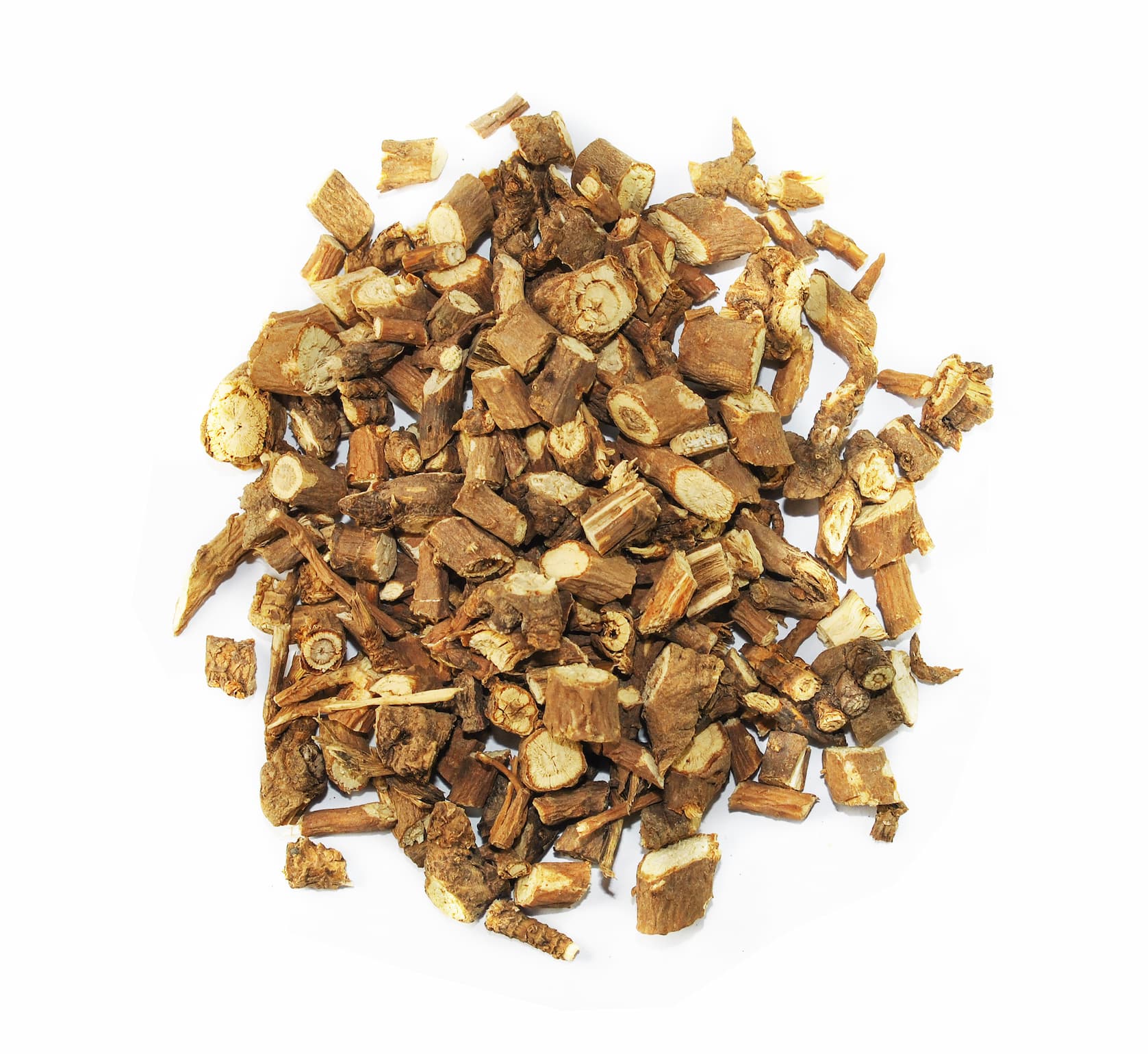
Bupleurum is a slender perennial herb growing 50 to 85 cm tall with narrow, slightly sickle-shaped leaves -- hence one of its English names, Hare's Ear Root. Its small yellow-green flowers are typical of the Apiaceae family, and the resemblance to fennel or dill is not accidental; they are genuine botanical relatives. The root is thin, cylindrical, and earthy brown, with a slightly bitter taste and a faint aromatic quality.
The two official species are used somewhat differently in practice. North Bupleurum (Bei Chai Hu) is harder and more effective for resolving Shaoyang disorders and reducing fever. South Bupleurum (Nan Chai Hu) is softer and considered more effective for spreading Liver Qi and relieving stagnation. Both are officially recognized in the Chinese Pharmacopoeia.
One important identification note: Da Ye Chai Hu (large-leaf Bupleurum, B. longiradiatum) is a toxic species sometimes confused with authentic Chai Hu and is explicitly listed as unfit for medicinal use in the Chinese Pharmacopoeia. Yin Chai Hu (银柴胡) is a completely different herb from a different plant family that shares only the name -- it clears deficiency heat and is not interchangeable with Chai Hu under any circumstances.
Uses
Pungent and bitter in flavor, slightly cool in nature, Chai Hu enters the Liver and Gallbladder channels primarily. It has three distinct clinical applications, and it is worth being precise about them because they operate at different dosages and in genuinely different contexts.
Resolving Shaoyang disorders. In Zhang Zhongjing's classical framework, illness can become lodged at the Shaoyang level -- the half-exterior, half-interior zone where a pathogen has moved past the surface but hasn't penetrated fully to the interior. The characteristic presentation is alternating chills and fever, bitter taste in the mouth, dry throat, dizziness, chest and rib-side fullness, and irritability. Chai Hu is the essential herb for this pattern, and Xiao Chai Hu Tang -- Minor Bupleurum Decoction -- remains one of the most studied classical formulas in the world for this reason.
Spreading Liver Qi. This is where Chai Hu earns most of its modern clinical use. The Liver, in TCM, governs the smooth, free movement of Qi throughout the body. When Liver Qi stagnates -- typically from emotional stress, frustration, or prolonged constraint -- the result is rib-side pain or tightness, a stifling sensation in the chest, irritability, sighing, digestive disruption, and irregular menstruation. Chai Hu is the primary herb for releasing this constraint. It almost always appears alongside Bai Shao (white peony root), which nourishes the Liver's substance and prevents Chai Hu's dispersing action from depleting Yin over time.
Raising Yang Qi. At lower doses, Chai Hu has a third application: lifting sunken Yang Qi in Spleen deficiency patterns -- prolapse, chronic diarrhea, fatigue with a sinking quality. In this context it is typically combined with Sheng Ma to amplify the upward movement.
The dosage-dependence is clinically specific: low dose (3-6g) for raising Yang, medium dose (6-10g) for moving Liver Qi, higher dose (10-15g or more) for resolving Shaoyang patterns. This is the kind of detail that distinguishes practiced clinical use from formula-by-number herbalism.
Modern research has focused primarily on saikosaponins -- the major active compounds -- which have demonstrated anti-inflammatory, hepatoprotective, and immunomodulatory effects in laboratory studies. Research on Xiao Chai Hu Tang for chronic hepatitis B and C has produced some promising findings. There is also preliminary evidence for antidepressant effects, consistent with the traditional Liver Qi stagnation indication. The usual caveats apply: most evidence is preclinical, and well-powered human trials remain limited.
Cautions
Contraindicated in Yin deficiency with heat signs -- dry mouth, red tongue with little coating, night sweats. Chai Hu's ascending and dispersing nature can worsen Yin depletion in these patterns. Similarly avoid where Liver Yang is already rising (headache, dizziness, hypertension presentations). Use with caution in loose stool or chronic diarrhea. Modern research has documented potential hepatotoxicity at supra-therapeutic doses, so prolonged high-dose use warrants monitoring. And again: the large-leaf species (B. longiradiatum) is toxic and must never be used as a substitute.
Uses in Herbalogic Formulas
Chai Hu appears in three Herbalogic formulas. In all three it is doing the same work: spreading Liver Qi. But each formula arrives at that need from a different direction.
Decompress is Xiao Yao San -- offered as close to the classical formula as possible, because some formulas have earned that kind of respect. Xiao Yao San translates roughly as "Rambling at a Distance," a Zhuangzi image of moving through the world without friction. Chai Hu leads it for a reason: when Liver Qi is constrained, Chai Hu is what starts moving it again.
Peacekeeper is Xiao Yao San aimed specifically at the emotional and physical terrain of PMS, with two additional herbs to keep the highs from going too high and the lows from going too low. Chai Hu's job here is the same as always: dissolving the constraint before it builds into something harder to move.
Flashback is focused on occasional hot flashes, and its foundation includes Xiao Yao San for a specific reason: for some people, stress is a trigger. Constrained Liver Qi can add fuel to the fire. Chai Hu addresses that mechanism -- not the heat itself, but the stagnation that can make it worse.
The herb that may or may not mean "kindling of the barbarians" has been loosening what was stuck for nearly two thousand years. It's still good at it.