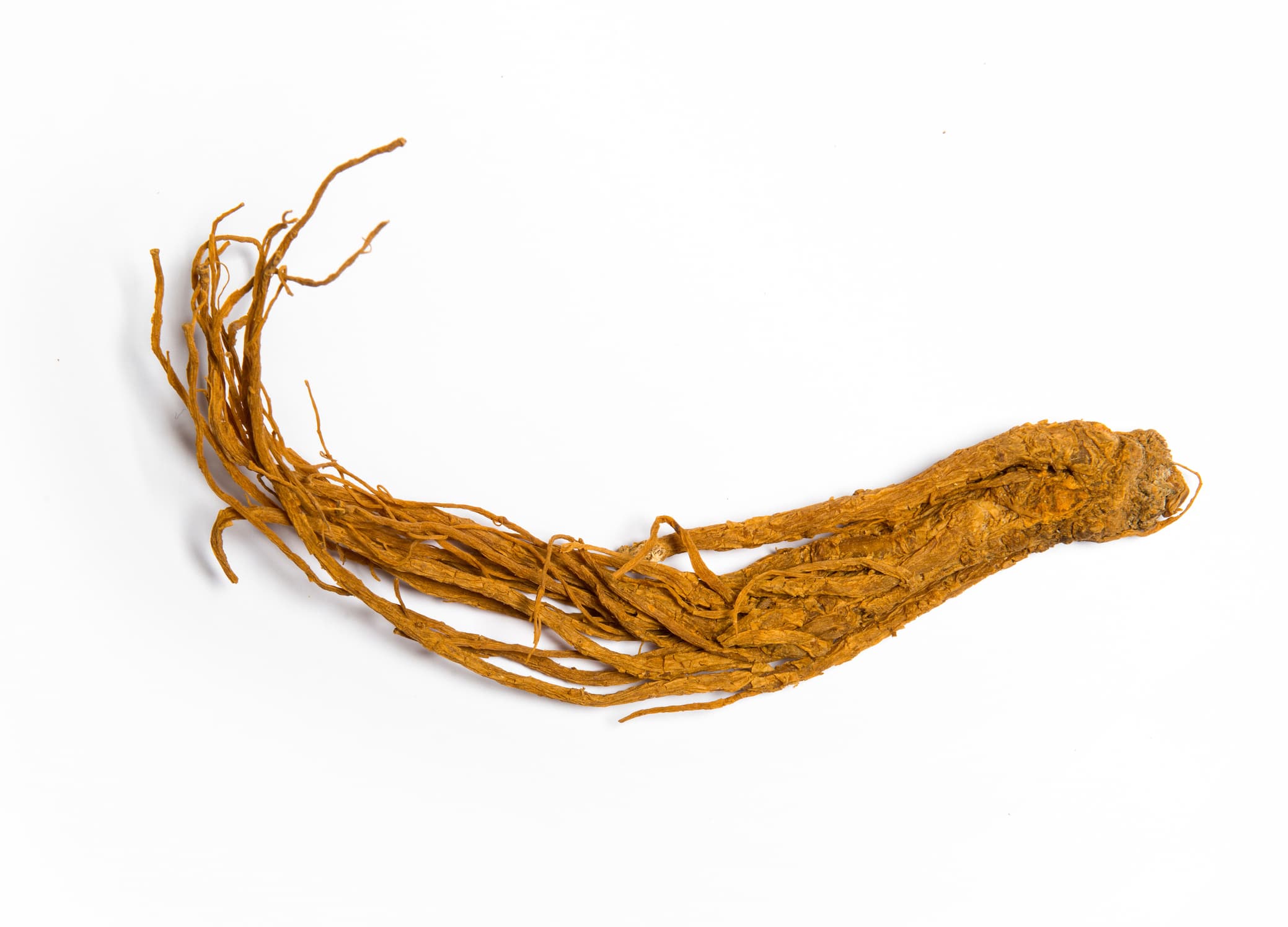
The herb whose name is a promise -- and whose job is to keep it.
There's a folk story about how Dang Gui got its name. A man left home to find a cure for his ailing wife, following a Taoist healer into the mountains of Gansu. Three years of apprenticeship later, he returned with the herb. The Taoist's parting words were 应当归矣 -- "you should return now." And so the herb was named 当归: dang, meaning "ought to" or "should"; gui, meaning "to return."
Whether or not the story is literally true, the name stuck for a reason. It captures something real about what the herb does. Dang Gui's clinical logic -- in TCM and across 2,000 years of use -- is fundamentally about return: bringing blood back to where it belongs, restoring flow where it has stalled, rebuilding what has been depleted. The name is a description dressed up as a story.
It also got saddled with the nickname "female ginseng" somewhere along the way, which is accurate in the same limited sense that ginger is "the nausea herb." That's where the pattern shows up most visibly. But Dang Gui is a blood herb, not a women's herb, and it's prescribed for men and women equally when the pattern fits. Half your formulas don't care what gender you are.
Herb Name Essentials
Scientific Name: Angelica sinensis (Oliv.) Diels
Common Name (Western): Chinese Angelica Root
Chinese Name (Pin Yin): 当归 Dang Gui
Origin: Cultivated primarily in Gansu Province, China, particularly Min County, which accounts for roughly 70% of national production. Grown at high altitudes between 2,200 and 3,000 meters in cool, mountainous terrain.
Description
Chinese Angelica Root belongs to the Apiaceae family -- the same family as parsley, carrot, and celery -- and it shows. The plant is a tall, leafy biennial with globe-like clusters of small white flowers on compound umbels, the characteristic architecture of the parsley family. The part used is the root, which is thick, branched, and yellowish-brown with a fibrous, wrinkled exterior.
The aroma is the giveaway. Dang Gui has a strong, sweet, earthy smell with a sharp, almost celery-like edge -- pungent enough that experienced practitioners can identify it across a room. Farmers and dealers in Gansu still use smell as a primary quality criterion, alongside root size. The volatile phthalides responsible for that aroma, particularly Z-ligustilide, are also among the herb's key active constituents.
The root is harvested in autumn, but the timing is less casual than it sounds. Seedlings are started in nursery beds and transplanted in late spring or early summer, then pulled the following autumn -- roughly 18 months from transplant to harvest. That window is not negotiable. If the plant is left in the ground long enough to flower and bolt in its second year, the root lignifies and becomes commercially worthless. The entire cultivation enterprise is essentially a race to get the root out of the ground before the plant decides it's finished being a root. Research on Gansu cultivation confirms the stakes: early-bolting roots show measurably lower concentrations of both ferulic acid and ligustilide -- the two constituents most associated with the herb's activity -- alongside the structural lignification. The traditional harvest timing isn't folklore. It tracks with the chemistry.
The root is typically sold and used whole, but classical TCM distinguishes three sections with subtly different actions: the head (Dang Gui Tou), which is the most tonifying and has some hemostatic function; the body (Dang Gui Shen), which most strongly nourishes blood; and the rootlets (Dang Gui Wei), which most strongly invigorate and move blood. When the whole root is used together -- Quan Dang Gui -- you get all three actions at once, which is how it appears in most modern formulas including Herbalogic's.
Uses
Nature: warm. Taste: sweet, acrid, bitter. Channels: Heart, Liver, Spleen.
What makes Dang Gui genuinely unusual in its category is that it does two things most blood tonics can't. It nourishes blood -- building the substance itself, addressing the pale complexion, fatigue, and restlessness of blood deficiency. And it moves blood -- gently invigorating circulation, warming the channels, and clearing the stagnation that depleted blood tends to produce. Most herbs in the blood-tonifying category do one or the other. Dang Gui does both, which is why classical texts describe it as tonifying, invigorating, and harmonizing the blood. Three actions, one root.
The clinical implications are wide. Blood deficiency in TCM is not a single presentation -- it manifests differently depending on which organ system is most affected. When the Liver stores insufficient blood, the sinews and tendons lose their nourishment, producing stiffness, cramping, and the kind of chronic aching pain that worsens with rest and cold. When the Heart lacks blood to anchor the spirit, sleep becomes restless, the mind unsettled, and emotional resilience thins. When blood stagnates rather than circulates -- whether from cold, deficiency, or trauma -- pain becomes fixed and persistent. Dang Gui addresses all three through a single mechanism: restore the blood, get it moving, and let the tissues it was supposed to be nourishing do their job.
The herb also moistens the intestines, which makes it useful for the dry, sluggish digestion that accompanies blood deficiency -- the kind common in older patients and anyone recovering from prolonged illness.
Modern research has identified ferulic acid and Z-ligustilide as two of the primary active constituents. Ferulic acid has demonstrated effects on blood cell production and circulation in laboratory and animal studies. Z-ligustilide shows anti-inflammatory and antispasmodic activity in preclinical research. These findings are consistent with traditional use but most of the meaningful clinical research remains in early stages -- interesting, but not yet the whole story.
Cautions
Dang Gui contains coumarins and can potentiate the effects of warfarin and other anticoagulant medications -- this is a real interaction worth knowing about. Use cautiously if you are taking blood thinners, and consult your physician before adding it to your routine.
Avoid during pregnancy without practitioner guidance. Dang Gui has uterine-stimulating properties and is contraindicated in early pregnancy, though it has a long history of use in postpartum recovery under appropriate supervision.
Not appropriate for damp-heat patterns or where loose stool from dampness is present. The herb's warming, moistening nature can aggravate these conditions.
Uses in Herbalogic Formulas
Dang Gui appears in five Herbalogic formulas, which tells you something about how central the Liver Blood axis is to the conditions these formulas address.
Back in Action
Dang Gui addresses the blood deficiency and stagnation component of musculoskeletal discomfort -- nourishing the sinews and tendons while gently moving blood through the channels. Chronic physical discomfort often has a blood component that purely anti-inflammatory approaches miss.
See Back in ActionDecompress
Dang Gui provides the blood-nourishing foundation that emotional regulation formulas depend on. The Liver needs adequate blood to maintain smooth flow of qi -- without it, tension and emotional fragility tend to follow. Dang Gui is part of what keeps this formula grounded rather than just moving qi around in an already depleted system.
See DecompressPeacekeeper
Same logic as Decompress -- blood nourishment as the substrate for emotional steadiness. When Liver Blood is adequate, the Liver can do its job of keeping qi moving smoothly. When it isn't, even good qi-moving herbs are working against a headwind.
See PeacekeeperFlashback
In Flashback, Dang Gui works alongside herbs that nourish Kidney Yin -- Liver Blood and Kidney Yin are closely connected in TCM, and supporting one tends to support the other. It also provides gentle circulation support to a formula that's doing a lot of nourishing work.
See FlashbackStand Down
Dang Gui plays a grounding role here -- blood nourishment as the substrate for a more stable nervous system response. Stand Down is a practitioner-only formula not available through our general store. If you think it might be relevant to your situation, ask your acupuncturist or herbalist -- or reach out to us and we'll help you find someone who can make that call.
Five formulas. One herb. One job: bring things back to where they belong.