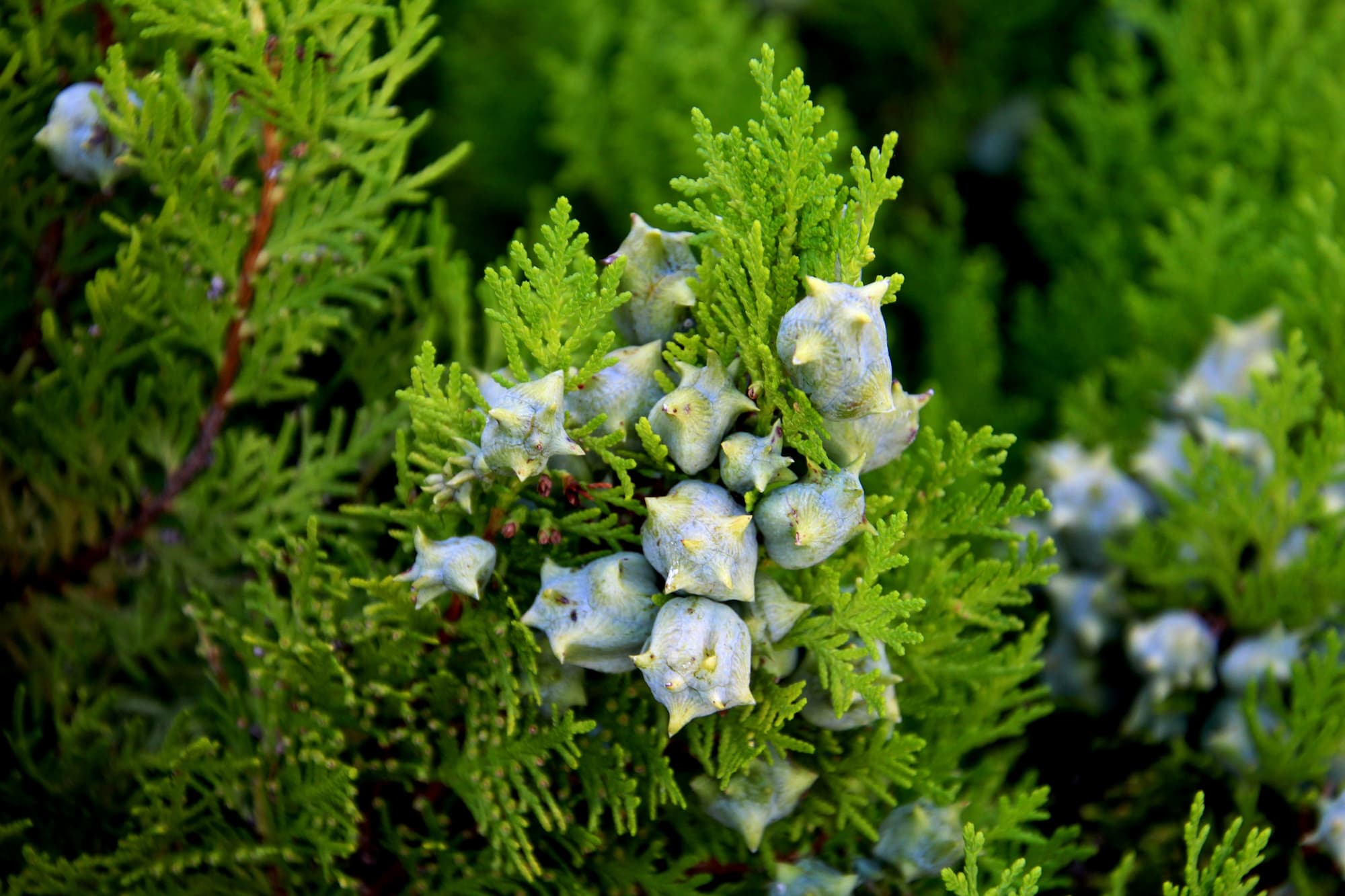
The tree that outlasts everything -- including your nervous system's objections
There's a tree that grows on dry, rocky slopes in northern China that has been associated with longevity since at least the Han dynasty. Not in a vague, "eat your vegetables" kind of way -- there's an actual legend, recorded in multiple classical texts, about a woman from the Qin dynasty court who fled into the Zhongnan Mountains after the dynasty collapsed and survived for more than a hundred years on nothing but cypress seeds and resin. She was reportedly found centuries later, still moving nimbly, with black hair. Whether you take that story literally is your business, but it tells you something about how Chinese herbalists thought about this plant: patient, persistent, quietly nourishing.
The cypress tree in question -- Platycladus orientalis, the Oriental arborvitae -- is a slow-growing conifer that thrives in continental climates, the kind with scorching summers and punishing winters. It can live for centuries. The common name "arborvitae" comes from Latin meaning "tree of life," and the connection to Buddhist temple construction and incense burning only deepened the association with steadfastness and longevity. The seeds are small, oily, and pale yellow-white -- harvested in autumn, dried in shade, and typically crushed before use to release the oils that give them most of their medicinal character.
The Shen Nong Ben Cao Jing, the oldest recorded Chinese materia medica, classified Bai Zi Ren as a top-grade herb -- safe for long-term use, capable of prolonging life. Li Shizhen, writing in the Ben Cao Gang Mu in the 16th century, praised its clear fragrance as something that could "penetrate Heart and Kidney." That's a poetic way of saying the herb's action reaches into both the emotional and the constitutional. It's not just calming the surface. It's nourishing what's underneath.
Herb Name Essentials
Platycladus orientalis (L.) Franco
Common Name (Western)
Biota Seed, Arborvitae Seed
Chinese Name (Pin Yin)
Bai Zi Ren 柏子仁
Part Used
Dried ripe seed
Family
Cupressaceae (cypress family)
Origin
Primarily Hunan, Hebei, and Shandong provinces; harvested in autumn
Description
The Oriental arborvitae is a slow-growing evergreen conifer that typically reaches 15 to 20 meters, though specimens on sheltered slopes can grow considerably taller given enough time. Its foliage forms distinctive flat, vertical sprays of tiny scale-like leaves, bright green that may turn brownish-copper in winter. The cones are blue-green at first, ripening to reddish-brown about eight months after pollination. The seeds inside are small, ovoid, and wingless -- about 4 to 6mm long -- with a thin membranous coat and a mild aromatic fragrance that intensifies when crushed.
Bai Zi Ren should not be confused with Ce Bai Ye, the leaf of the same tree, which is used for cooling the blood and stopping bleeding -- a completely different clinical application.
The processed form Bai Zi Ren Shuang -- where the oil is pressed out -- is used clinically when the moistening quality would cause loose stools, trading some of the nourishing benefit for better digestive tolerance.
Uses
Sweet and neutral in nature, Bai Zi Ren enters the Heart, Kidney, and Large Intestine channels.
In TCM, the Heart houses the Shen -- the spirit, consciousness, and capacity for emotional coherence. When Heart Blood or Yin is deficient, the Shen has no firm ground to rest on. The result is restlessness, difficulty settling at night, a mind that keeps spinning when it should quiet down, palpitations, and a sense of vague unease that doesn't resolve with ordinary relaxation. Bai Zi Ren addresses this pattern directly: nourishing the blood and yin that anchor the Shen, rather than simply suppressing the agitation at the surface.
It's worth noting that Bai Zi Ren is often paired with Suan Zao Ren (sour jujube seed) in classical formulas -- most famously Tian Wang Bu Xin Dan. The two herbs are complementary: Suan Zao Ren is more specifically liver-nourishing and astringent, Bai Zi Ren is more oily and moistening. Together they cover more of the deficiency pattern than either does alone.
The herb also addresses two secondary presentations that show up with the same underlying deficiency: night sweats (yin deficiency allowing heat to push fluids out at night), and occasional constipation in people who are dry and deficient rather than stagnant. The same moistening quality that nourishes Heart Blood also lubricates the Large Intestine. It's one of those herbs where the secondary actions are a direct extension of the primary logic, not a separate mechanism.
Modern research on Bai Zi Ren is still limited, but a few studies are worth noting. An ethanol extract showed antidepressant-like effects in animal models, apparently acting on serotonin, norepinephrine, and dopamine pathways. Another study found that compounds from the seed modulated amyloid-beta aggregation in an Alzheimer's model. These findings are preliminary -- the usual in-vitro and animal-model caveats apply -- but they point in directions consistent with the traditional indication of calming the mind and sharpening cognition over time.
Cautions
Use with caution if loose stools are present -- the oily nature of the seed can worsen this. The processed, defatted form (Bai Zi Ren Shuang) is the appropriate choice in those cases. Some classical texts note an antagonism with Chrysanthemum (Ju Hua), though this is rarely cited as a significant clinical concern in modern practice. Avoid in cases of Phlegm accumulation, where moistening herbs are generally contraindicated.
Bai Zi Ren appears in Stand Down, Herbalogic's formula for hypervigilance presentations -- the kind of accumulated tension that won't let go even when there's nothing left to defend against. Stand Down is a modified Tian Wang Bu Xin Dan, and Bai Zi Ren plays its classical role here: nourishing the blood and yin that give the Shen something solid to rest on, working alongside Suan Zao Ren to cover the deficiency pattern from two complementary angles. It's not the activating ingredient; it's the one making space for the system to actually settle.
Stand Down is a practitioner-only formula -- not available through the general store. If you think it might be right for you, ask your acupuncturist or herbalist, or reach out to us and we'll help you find someone who can make that call.
The tree outlasted the dynasty. The seeds have been doing this work for a long time.