The fastest-growing plant on Earth, deployed for its calming properties. Make of that what you will.
If you've ever watched bamboo grow, you know it doesn't do anything slowly. Some species put on two inches an hour. You can allegedly sit and watch it move. It's less a plant than a project, an unrelenting vertical ambition that has inspired everything from construction materials to paper to the occasional cautionary tale about what happens when you plant it near your neighbor's fence.
So it's a little unexpected that one of bamboo's most valued contributions to traditional Chinese herbal medicine is in formulas for restless sleep and an agitated mind. The plant that grows faster than most things can move, contributing to the project of slowing down. There's something almost philosophical about that, though I'll resist the temptation to lean into it too hard.
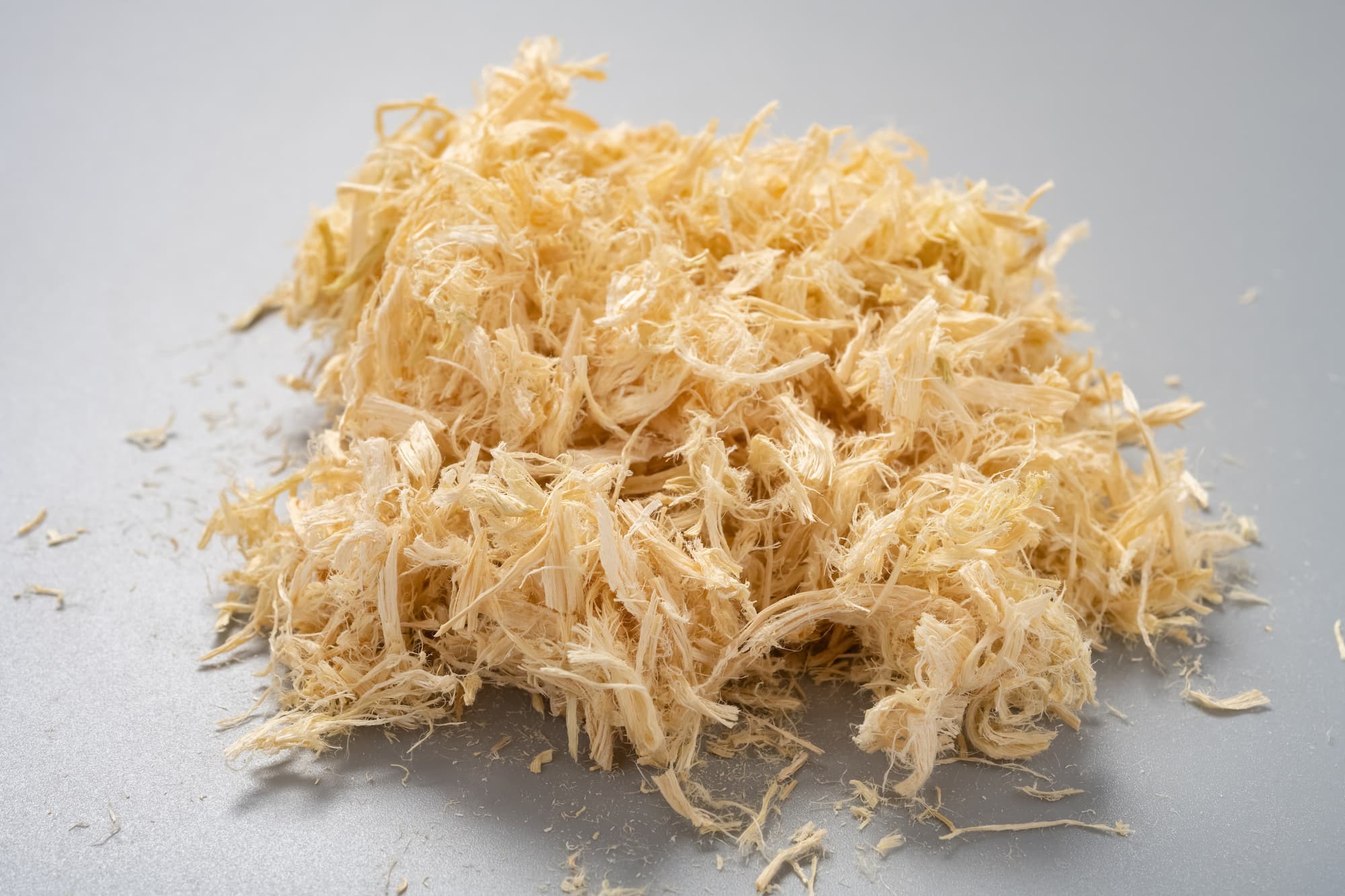
What TCM practitioners are actually after isn't the shoot, or the leaf, or the root. It's a thin scraping from just beneath the outer bark of the stem -- the pale, slightly fibrous middle layer that peels away in long curling strips. Fresh, it has a faint greenish-white color. Dried, it looks a bit like coarse wood shavings or loosely matted fiber. It's not glamorous. It's not what you'd guess was medicinally significant if you picked it up. But in classical Chinese medicine, what something looks like has never been the point.
Herb Name Essentials
| Scientific Name | Bambusa tuldoides Munro, Sinocalamus beecheyanus var. pubescens, or Phyllostachys nigra var. henonis |
| Common Name | Bamboo Shavings |
| Chinese Name | Zhu Ru 竹茹 |
| Origin | Cultivated throughout southern and central China; harvested in all seasons by scraping the middle layer of mature stems after removing the outer bark |
Description
Bamboo belongs to the grass family (Poaceae) -- which still surprises people, because it doesn't behave much like grass. The species used for Zhu Ru are large, woody, clumping or running bamboos native to southern China and Vietnam, capable of reaching 7-15 meters in height with stems up to 50mm in diameter.
The part used in medicine is technically called the stratum intermedium of the culm -- the fibrous middle layer of the stem wall, accessed by first shaving away the hard outer bark and then scraping the paler material beneath. The resulting shavings are off-white to pale green, lightweight, and slightly fibrous in texture. They can be used fresh, dried in sunlight, or processed with ginger juice -- a preparation called Jiang Zhu Ru, which shifts the herb's emphasis slightly toward its anti-nausea function.
This is one of the few herbs in the materia medica where the part used is essentially a byproduct of processing. You can't grow Zhu Ru. You can only make it.
Uses
Zhu Ru is sweet in flavor and slightly cold in nature. It enters the Lung, Stomach, and Gallbladder channels. Its primary actions are three, and they're worth understanding separately.
The first is clearing Phlegm-Heat from the Lungs -- addressing cough with thick yellow sputum and a stifling sensation in the chest. But the more clinically interesting consequence of this action, in the context of occasional sleeplessness and nervous tension, is what happens when Phlegm-Heat is cleared from the Heart. When this kind of turbid Heat accumulates and disturbs the spirit, the result is restlessness, palpitations, and difficulty quieting the mind at bedtime. Zhu Ru addresses this not by directly sedating, but by removing the Heat that's doing the disturbing. It's a distinction that matters in TCM -- you're not suppressing the symptom, you're resolving the underlying condition.
The second action is clearing Heat from the Stomach and redirecting rebellious Stomach Qi downward -- making it one of the classical herbs for nausea and vomiting from Heat patterns, including morning sickness. This is the function Zhu Ru is probably most famous for historically, anchoring formulas like Ju Pi Zhu Ru Tang from Zhang Zhongjing's Jin Gui Yao Lue.
The third is cooling Blood and stopping bleeding -- nosebleed and coughing of blood in Heat patterns. Less commonly emphasized in modern use, but part of the complete picture.
The Gallbladder connection is worth a separate note. In TCM, the Gallbladder governs decisiveness, courage, and the ability to settle the mind. When Phlegm-Heat accumulates in the Gallbladder channel, the result is a particular kind of agitation -- restlessness, being easily startled, a sense of timidity or unease that doesn't have a clear external cause. Zhu Ru specifically disperses clumped Phlegm-Heat in the Gallbladder channel, which is part of why it anchors Wen Dan Tang ("Warm the Gallbladder Decoction") -- one of the most well-studied classical formulas for restless, dream-disturbed sleep. Despite the formula's name, its overall action is gently clearing and calming rather than warming, a quirk of classical naming conventions that continues to continue confuse students.
A systematic review and meta-analysis covering 79 studies and 7,886 participants found TCM formulations built around Wen Dan Tang to be more effective than benzodiazepines for improving global sleep quality. That's a citation worth noting, with the usual caveats about study heterogeneity and the difficulty of blinding herbal medicine trials.
Cautions
Zhu Ru should not be used in cases of Spleen Deficiency with Cold, or for cough arising from a Cold pattern. As a slightly cold herb, it's contraindicated where the underlying condition is already Cold in nature -- using it in those cases would push the pattern in the wrong direction. Consult a qualified practitioner if you're unsure about your pattern.
Zhu Ru appears in Stand Down for exactly the reason the research suggests -- its ability to clear the Phlegm-Heat that accumulates in the Gallbladder and disturbs the spirit, contributing to the restlessness and difficulty winding down that Stand Down is formulated to address. It's not the loudest herb in the formula, but it's doing specific work that other herbs in the calming-spirit category don't cover. In TCM formulation, that specificity is the point.
Learn About Stand Down →Bamboo has been growing fast and shading everything around it for millions of years.
Occasionally it's nice to borrow a little of what's underneath the surface.